If a dentist in Korea has told you that you need a bone graft or a sinus lift before your implant, it can sound alarming — and it's often the reason two quotes for "one implant" are so far apart. Here's what these procedures actually are, when they're genuinely needed, and what to ask before you agree, in English.
An implant isn't attached to your gum — it's anchored in the bone of your jaw. So before anything is placed, your dentist has to answer one question: is there enough bone, in the right place, to hold it? When the answer is no, the fix is usually a bone graft, or — in the upper back jaw — a sinus lift. Here's what that means, in plain English for foreign residents in Korea.
Why bone is the whole story
An implant works because bone grows tightly onto its surface and locks it in place. That needs enough bone height and width around the implant, and enough clearance from two things you don't want to hit: the nerve that runs through the lower jaw, and the sinus cavity above the upper back teeth.
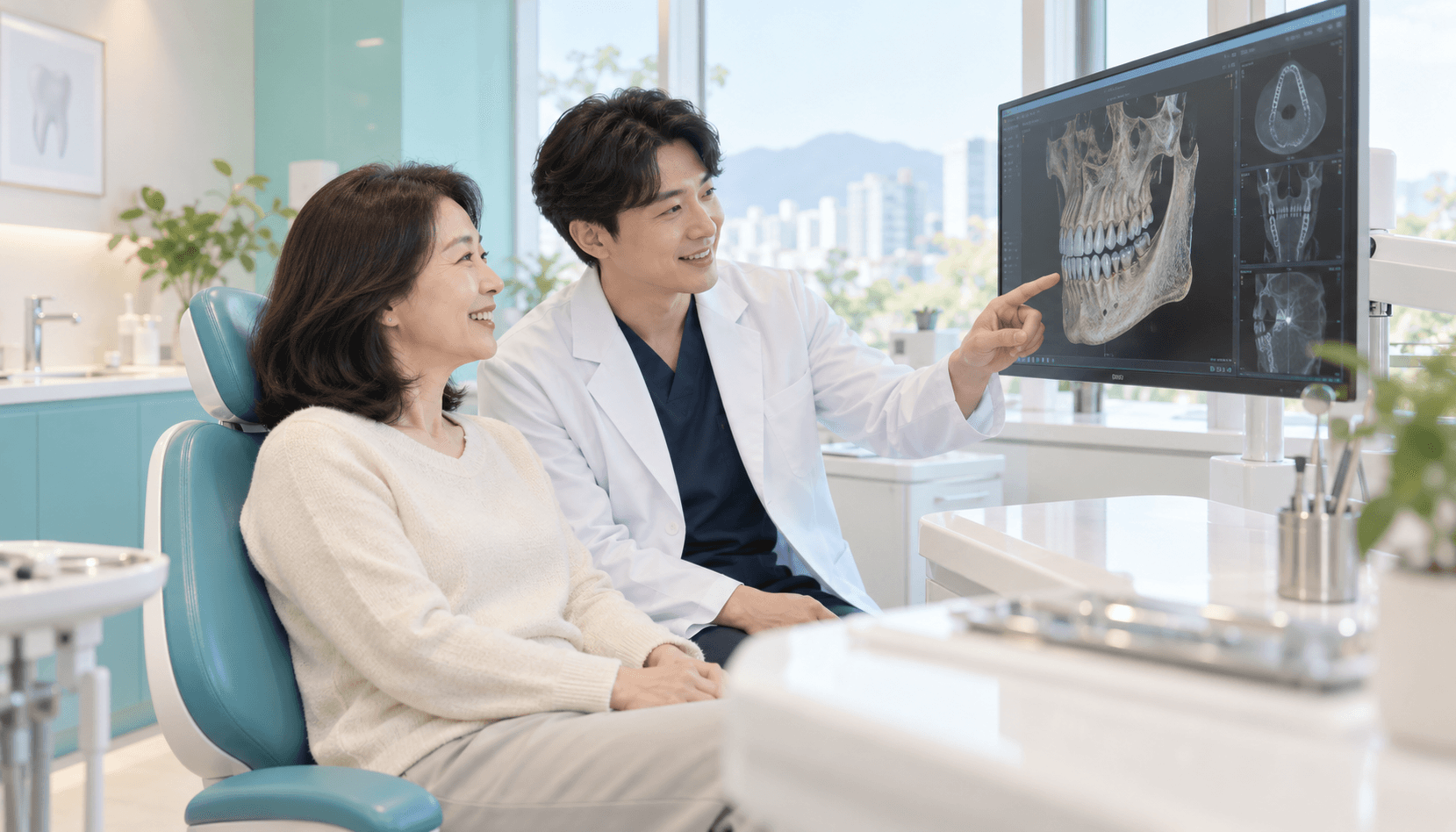
This is exactly what a 3D CT scan is for. A flat X-ray shows you a shadow; a CT shows the bone in three dimensions, so the position, angle and length of the implant can be planned before anything is decided.
Why bone goes missing
Bone doesn't disappear at random. The usual reasons:
- Time without a tooth. The bone that held a tooth root shrinks once the root is gone, and most of that change happens in the first year.
- Gum disease. Advanced gum disease destroys the bone that supports the teeth — often silently.
- A difficult extraction, or a long-standing infection that ate into the bone before the tooth came out.
- Years of wearing a denture over the same ridge.
- Your own anatomy. Some people simply have a low sinus floor or a naturally thin ridge.
The types of graft you might be offered
| What it's called | What it's for |
|---|---|
| Socket preservation | A graft placed into the socket at the moment a tooth is taken out, to keep the ridge from collapsing |
| Guided bone regeneration (GBR) | Building up width or height around an implant, usually with a membrane over the graft |
| Block graft | A larger defect, rebuilt with a block of bone fixed in place |
| Sinus lift | Creating bone height under the sinus in the upper back jaw |
The graft material itself is usually your own bone, processed donor or animal-derived bone, or a synthetic substitute. All are used routinely in Korea — ask which one is planned for you and why.
Sinus lift: why upper back teeth are different
Above your upper molars sits the maxillary sinus, an air space. When an upper back tooth is lost, the floor of that sinus tends to drop and the bone below it thins — sometimes to the point where an implant has nowhere to sit. A sinus lift raises that floor and places graft material underneath, creating the height you need.
There are two ways it's done:
- Crestal (internal) lift — a small lift made through the implant site itself. Used when only a few millimetres are needed, and usually done in the same appointment as the implant.
- Lateral window (external) lift — a larger lift through a small window in the side of the jaw. Used when much more height is needed, and the implant may be placed later.
Your CT decides which one applies. It isn't a matter of preference.
Does it add time?
Often less than people expect, and sometimes none at all:
| Situation | Usually means |
|---|---|
| Small graft placed at the same time as the implant | No extra appointments; normal healing time |
| Socket preservation at the time of extraction | A wait before the implant goes in, commonly a few months |
| Larger graft or lateral sinus lift done first | The implant is usually placed after several months of healing |
These are general patterns, not a schedule. Your dentist can only give you real timings after the scan and exam.
This is why implant quotes differ
If you've collected quotes and the numbers don't line up, grafting is one of the most common reasons. "One implant" can mean very different things:
- Does the price include the crown on top, or only the implant in the bone?
- Does it include a bone graft or sinus lift, the graft material, and the membrane?
- Does it include the extraction, if the tooth is still there?
- Does it include a temporary tooth while you heal?
- Does it include the follow-up visits and the final checks?
A quote that's missing these isn't cheaper — it's incomplete. Ask for an itemised written estimate and compare line by line. Our guide to dental costs in Korea covers how to read one.
Do you always need it?
Not always, and it's a fair question to ask. Depending on what the CT shows, there may be room to use a shorter or narrower implant, to angle it differently, or to place it in a slightly different position and avoid grafting altogether. Sometimes a bridge or a denture is a reasonable alternative to the whole plan.
What you should expect is a dentist who shows you the scan and explains why the graft is needed in your case — not just that it is. If you're unsure, asking for a second opinion with a copy of your own CT is normal and reasonable.
Recovery, and what to expect
Most people find the recovery more manageable than they feared:
- Swelling and some discomfort for a few days, managed with the medication you're given.
- Soft food and chewing on the other side for a while.
- Don't smoke. Smoking is one of the clearest risks to a graft healing properly.
- After a sinus lift, avoid blowing your nose forcefully, and sneeze with your mouth open, for as long as your dentist tells you.
- Don't poke or disturb the site, and take any antibiotics exactly as prescribed.
Call the clinic if pain increases after the first few days, or if there's swelling that keeps growing — early is always easier.
Cost and insurance
In Korea, bone grafting done as part of implant treatment is generally private pay. NHIS covers implants only in limited cases — mainly patients aged 65 and over, up to two implants, with the patient paying a share (around 30%) — and grafting is normally outside that. Terms are set by NHIS, so confirm what applies to you.
Private or expat dental insurance may reimburse part of the cost. Ask for an itemised receipt that names each procedure and material, since that's what a claim will be assessed on.
Questions worth asking before you agree
- Can you show me on the CT where the bone is missing?
- Is the graft needed, or is it the safer of two workable options?
- What material will you use, and why that one?
- Is it done at the same time as the implant, or before it?
- What does the written estimate include — and what isn't in it?
At Seoul Lab Dental: we take a 3D CT, show you your own bone on screen, and tell you honestly whether a graft is genuinely needed for your case. You get an itemised written estimate before anything starts — explained in English.
Frequently asked questions
Is a bone graft painful?
It's done under local anaesthetic, so you shouldn't feel pain during it. Afterwards, most people have swelling and some soreness for a few days, managed with the medication you're given. A larger graft or a lateral sinus lift usually means more swelling than a small one placed alongside an implant.
Can I get an implant without a bone graft?
Sometimes. Depending on what the CT shows, a shorter or narrower implant, a different angle, or a slightly different position can avoid grafting. It depends entirely on your bone — which is why the scan comes before the plan, not after it.
How long after a bone graft can I get the implant?
If the graft is small and placed at the same time as the implant, there's no extra wait. If the graft is done first — such as socket preservation or a lateral sinus lift — the implant typically goes in after several months of healing. Your dentist can give you real timings once they've seen the scan.
Is a sinus lift dangerous?
It's a routine, well-established procedure planned from a 3D CT scan so the sinus floor and its position are known in advance. As with any surgery there are risks, and your dentist should explain the ones that apply to your case and the aftercare that reduces them — particularly not blowing your nose forcefully while it heals.
Does insurance cover a bone graft in Korea?
Bone grafting as part of implant treatment is generally private pay. NHIS implant coverage is limited to specific cases (mainly patients aged 65 and over, up to two implants, with a share of the cost), and grafting normally sits outside it. Private or expat dental insurance may reimburse part — ask for an itemised receipt.
Can I get this explained in English?
Yes. At Seoul Lab Dental we show you your CT scan, explain whether a graft is needed and why, and give you an itemised written estimate in English before treatment begins.
Want a clear estimate for your treatment?
Book a 3D scan and consultation — you'll leave knowing your treatment plan and exact cost.
Get my estimate