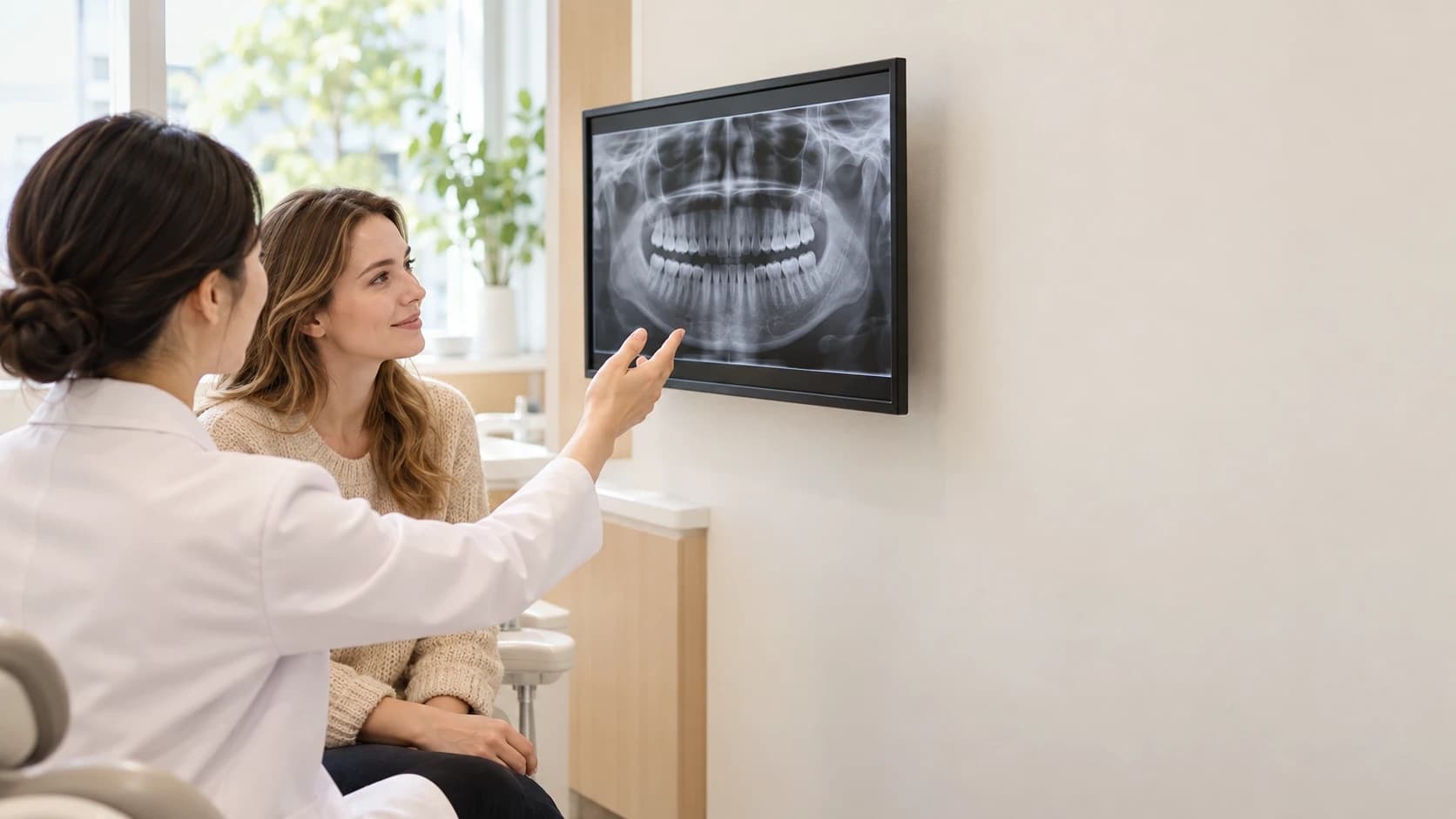
Most people mention they are leaving Korea at the last appointment. By then the choice has already been made for them. Said at the consultation instead, a departure date changes what a dentist should recommend — sometimes to something smaller, sometimes to nothing at all.
Contracts end, visas change, companies relocate people. Dental treatment is one of the few things that does not pack easily, because a lot of it is a sequence rather than an appointment — and a sequence has a minimum length that no amount of goodwill shortens.
Say the date at the consultation, not at the end
If you know roughly when you are leaving, say so before the plan is made.
This is the part that most changes the outcome. A dentist planning for someone who will be around for years and a dentist planning for someone with four months left should not arrive at the same recommendation. Told early, the date is an input. Told late, it is a problem.
"Roughly" is enough. Three months, around spring, when my contract ends in August — all of that is usable. You do not need a flight booked.
What fits in the time you have
| Treatment | What the timeline is governed by |
|---|---|
| Check-up, scaling, a simple filling | A single visit. No sequencing problem |
| Crown or bridge | Lab time between preparation and fitting, plus a fitting appointment. Needs a minimum run, not a single week |
| Root canal | Several visits, and the tooth usually needs a crown afterwards to be considered finished |
| Extraction | The removal is quick; healing is not instant, and a gap you plan to fill later is a separate decision |
| Implant | Healing months are built into the biology. This is the one that genuinely cannot be compressed |
| Braces or aligners | A long active phase with its own transfer problem — covered separately |
The pattern is that lab work and healing set the floor. A clinic can see you more often; it cannot make bone heal faster or a laboratory work in no time.
The states you do not want to leave in
Some treatments have a halfway point that looks finished and is not. These are the ones worth planning around:
- A root canal between visits, sealed with a temporary filling. Temporary materials are meant for weeks, not for a move abroad.
- A prepared tooth under a temporary crown. The tooth has been reduced and is relying on a cover that was never meant to last.
- An implant fixture placed with no crown on it. The hard part is done and the tooth is missing anyway.
- An extraction with a plan to fill the gap "later", where later is in another country and another currency.
None of these is a disaster, and all of them are fixable elsewhere. But each one hands the next dentist a case they did not start, and that is the most expensive way to arrive.
If the time is genuinely too short, the better answer is often not to begin — stabilise the problem, treat what is urgent, and let the full plan happen where you will be living. A dentist who says that is giving you the right advice, not turning away work.
What to take with you
You are entitled to your records. Ask for them before your last appointment, not on the day, because some of it takes a moment to prepare.
- The images as files, not as a printout. X-rays and any 3D scan are far more useful to the next clinic in their original digital form. Ask whether they can be put on a USB stick or sent to you.
- What was done, and to which tooth. Korean clinics use the same international two-digit tooth numbering as most of the world, so a tooth written as 36 or 46 means the same thing to a dentist anywhere. That makes a short treatment summary genuinely portable.
- Implant details, if you have one. The system and the component sizes matter. A dentist in another country who needs to work on your implant has to know what it is before they can order the part — and without that, servicing a crown can turn into replacing one. Many clinics issue a card or certificate for exactly this reason; keep it with your passport, not in a drawer.
- Receipts, if you intend to claim anything from an insurer later.
If you had work done in Korea and something needs attention after you have gone, this folder is the difference between a conversation and a guess.
Insurance, briefly
National Health Insurance cover is tied to your residence status in Korea, so it ends when that does. Anything treated after you leave is handled under whatever system applies where you are. If you are in the middle of a course of treatment and the dates are close, it is worth confirming your own position directly with NHIS rather than assuming — the rules on when cover stops are theirs, not your clinic's. What NHIS does and does not cover explains the dental side.
If you are coming back
A posting that ends with a return is a different calculation. Treatment with a long healing phase can sometimes be sequenced around a trip, and something that is stable is reasonable to leave stable. Say that too — "I am back in October" is as useful a piece of information as a departure date, and it occasionally turns an urgent-sounding plan into a patient one.
The short version
Tell the clinic when you are leaving, before anything is planned. Expect lab time and healing to set the pace. Do not start a sequence you cannot finish, and ask for your images as files. The goal is not to cram treatment in before a flight — it is to leave in a state that the next dentist can pick up without starting again.
At Seoul Lab Dental: bring your departure date to the consultation and we will tell you plainly what fits, what does not, and what is better left to do where you are going. Treatment is planned and explained in English by the dentist doing it, and your records and images are yours to take when you go.
Frequently asked questions
I am leaving Korea in two months. Can I still get an implant?
Usually not as a complete treatment. Implants have healing months built into the biology between placing the fixture and fitting the crown, and that part cannot be compressed by seeing you more often. Two months is generally enough to diagnose, treat anything urgent and plan — but starting a sequence you cannot finish leaves you abroad with a fixture and no tooth on it. Say your date at the consultation so the recommendation accounts for it.
What dental records should I take when I leave Korea?
Ask for your X-rays and any 3D scan as digital files rather than printouts, a short summary of what was done and to which teeth, and — if you have an implant — the system and component details, which the next dentist needs before they can order a matching part. Keep receipts if you plan to claim from an insurer. Request them before your final appointment, since some of it takes time to prepare.
Does my Korean health insurance still cover me after I leave?
No. National Health Insurance cover is tied to your residence status, so it ends when that does, and treatment after you leave falls under whatever system applies where you are. If you are mid-treatment and the dates are tight, confirm your own position with NHIS directly rather than assuming, because the rules on when cover stops are theirs.
Is it better to finish treatment in Korea or start again at home?
It depends on where in the sequence you are. Something that can be completed cleanly before you go is usually worth finishing. Something that would be left halfway — a root canal between visits, a prepared tooth under a temporary crown, an implant with no crown — generally is not, because the next dentist inherits a case they did not plan. If the time is genuinely short, treating what is urgent and leaving the full plan for later is often the better recommendation.
Want a clear estimate for your treatment?
Book a 3D scan and consultation — you'll leave knowing your treatment plan and exact cost.
Get my estimate