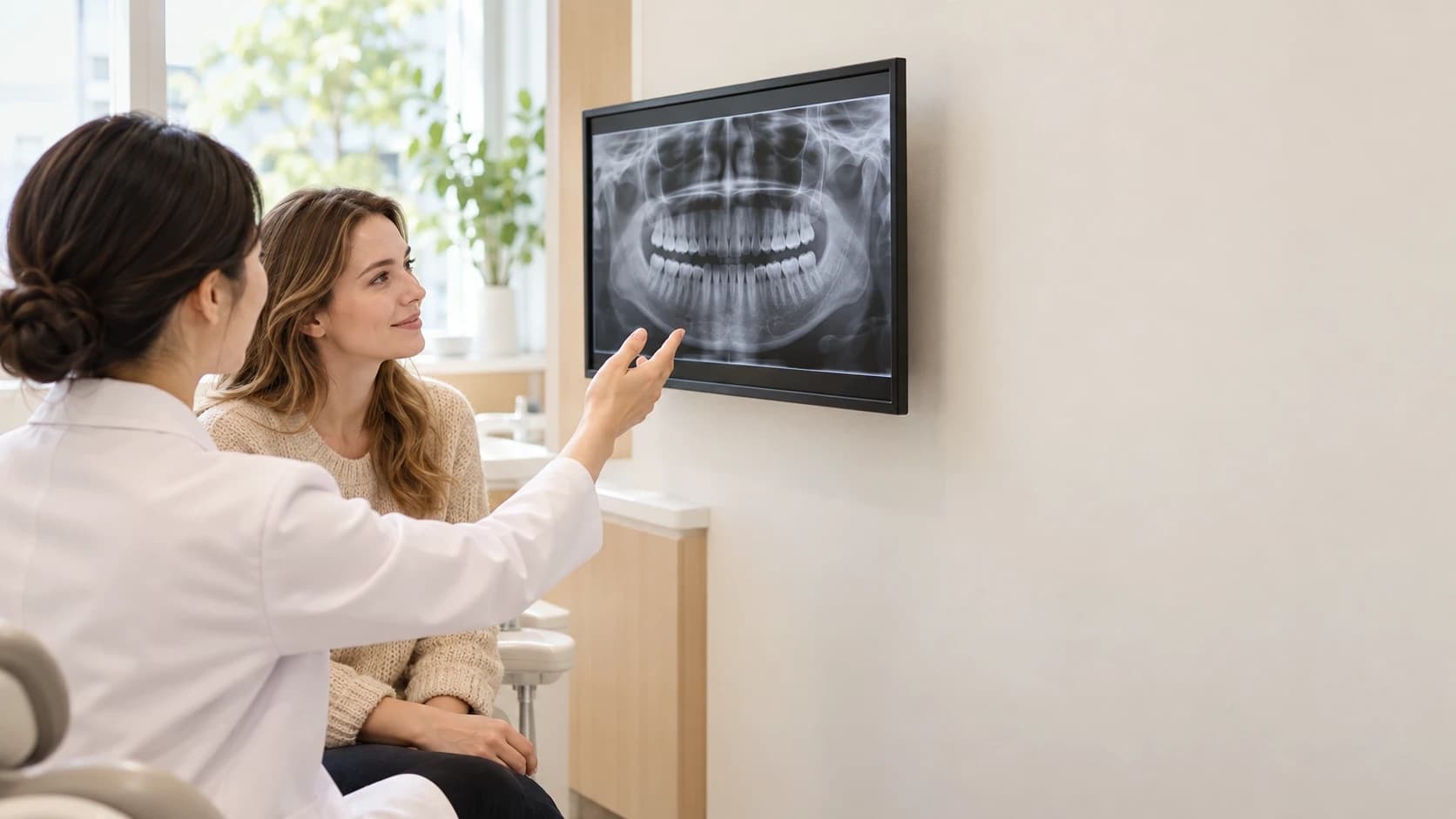
“It's a very small dose” is hard to take on trust in a language you don't speak. Here is what the images are, roughly what each involves, and when it is reasonable to ask whether you need one.
Nobody enjoys being told they need another X-ray, and "it's a very small dose" is a hard thing to take on trust in a language you do not speak. Here is what the images are, roughly what they involve, and when it is reasonable to ask whether you need one.
They are not all the same image
- Bitewing — a small film showing a few teeth where they meet. The everyday decay-check image, and the smallest dose of the three.
- Panoramic (OPG) — one wide image of both jaws, sinuses and joints. Useful for an overview, wisdom teeth, and planning. More than a bitewing, still small.
- 3D CT (CBCT) — a cone-beam scan producing a three-dimensional volume. Meaningfully more than a flat image, though a fraction of a hospital medical CT.
The jump that matters is from flat images to CBCT. A bitewing is routinely compared to a day or two of the background radiation everyone receives from the environment; a cone-beam scan is a larger step, which is why it should have a reason behind it rather than being part of every visit.
When a 3D scan actually earns its dose
There are cases where a flat image genuinely cannot answer the question, and guessing is worse than scanning:
- Implants — bone height, bone width, and the position of the nerve canal or sinus. A flat X-ray flattens a three-dimensional problem.
- Lower wisdom teeth sitting close to the nerve in the jaw.
- Root canal treatment that has not settled, where an extra canal or a crack may be hiding.
- Jaw joint, cysts, or anything where the shape matters in three dimensions.
For a filling, a cleaning or a routine check, it does not.
How often
There is no fixed schedule, and anyone who gives you one without examining you is guessing. The interval depends on how much decay you have had, your gum condition, your age, and what is being planned. Someone with no decay for a decade needs images far less often than someone being treated for active decay.
Two things reduce how many you need:
- Bring previous images. Scans from another clinic, or from another country, are often perfectly usable. If you can get a copy, take it with you — it may save a repeat.
- Ask for a copy of yours. You are entitled to your records, and having them avoids starting from zero if you move clinic or country.
Pregnancy, and children
Pregnancy. Dental X-rays are generally considered safe during pregnancy with appropriate shielding, because the beam is small and aimed away from the abdomen. "Safe" is not the same as "routine", though — non-urgent imaging is usually deferred, while urgent diagnosis is not delayed out of caution, since an untreated infection is its own risk. Say you are pregnant, or might be, before any image is taken.
Children. The same logic applies with smaller settings and a lower threshold for asking why. Children's tissues are more sensitive and their remaining lifetime is longer, so the question "do we need this now?" carries more weight, not less.
It is reasonable to ask
None of the following is rude, and a good clinic answers them without defensiveness:
- What will this image show that we don't already know?
- Could the one I had elsewhere be used instead?
- Will you show me the result and explain it?
That last one matters more than it sounds. An image you have had explained is a decision you can take part in; an image you never see is just something that happened to you.
At Seoul Lab Dental: we take a 3D scan when the treatment depends on what it shows — implants, wisdom teeth near the nerve, cases where a flat image cannot answer the question — and not as a default. If you bring usable images from another clinic, we will tell you honestly whether they are enough. Whatever we take, you will see it on screen with an explanation in English.
Frequently asked questions
Are dental X-rays safe?
The doses are small. A bitewing is routinely compared to a day or two of the natural background radiation everyone receives from the environment, and a panoramic image is somewhat more. A 3D cone-beam (CBCT) scan is a meaningfully larger step than a flat image, though still a fraction of a hospital medical CT — which is why a CBCT should have a specific reason behind it rather than being part of every visit.
When do I actually need a 3D CT scan?
When a flat image cannot answer the question: implant planning that depends on bone height and width and the position of the nerve canal or sinus, lower wisdom teeth sitting close to the nerve, root canal treatment that has not settled where an extra canal or crack may be hidden, and jaw joint or cyst cases where the three-dimensional shape matters. For a filling, a cleaning or a routine check, it does not.
How often should dental X-rays be taken?
There is no fixed schedule, and anyone who gives you one without examining you is guessing. It depends on your decay history, your gum condition, your age and what is being planned — someone with no decay for a decade needs images far less often than someone with active decay. Bringing usable images from another clinic can avoid a repeat.
Can I have a dental X-ray while pregnant?
Dental X-rays are generally considered safe during pregnancy with appropriate shielding, since the beam is small and aimed away from the abdomen. Safe is not the same as routine, though: non-urgent imaging is usually deferred, while urgent diagnosis is not delayed out of caution, because an untreated infection carries its own risk. Say you are pregnant, or might be, before any image is taken.
Can I bring X-rays from another clinic or country?
Yes, and it is worth doing. Images from elsewhere are often perfectly usable and may save a repeat. It is also worth asking for a copy of any images taken of you — you are entitled to your records, and having them means not starting from zero if you change clinic or move country.
Want a clear estimate for your treatment?
Book a 3D scan and consultation — you'll leave knowing your treatment plan and exact cost.
Get my estimate