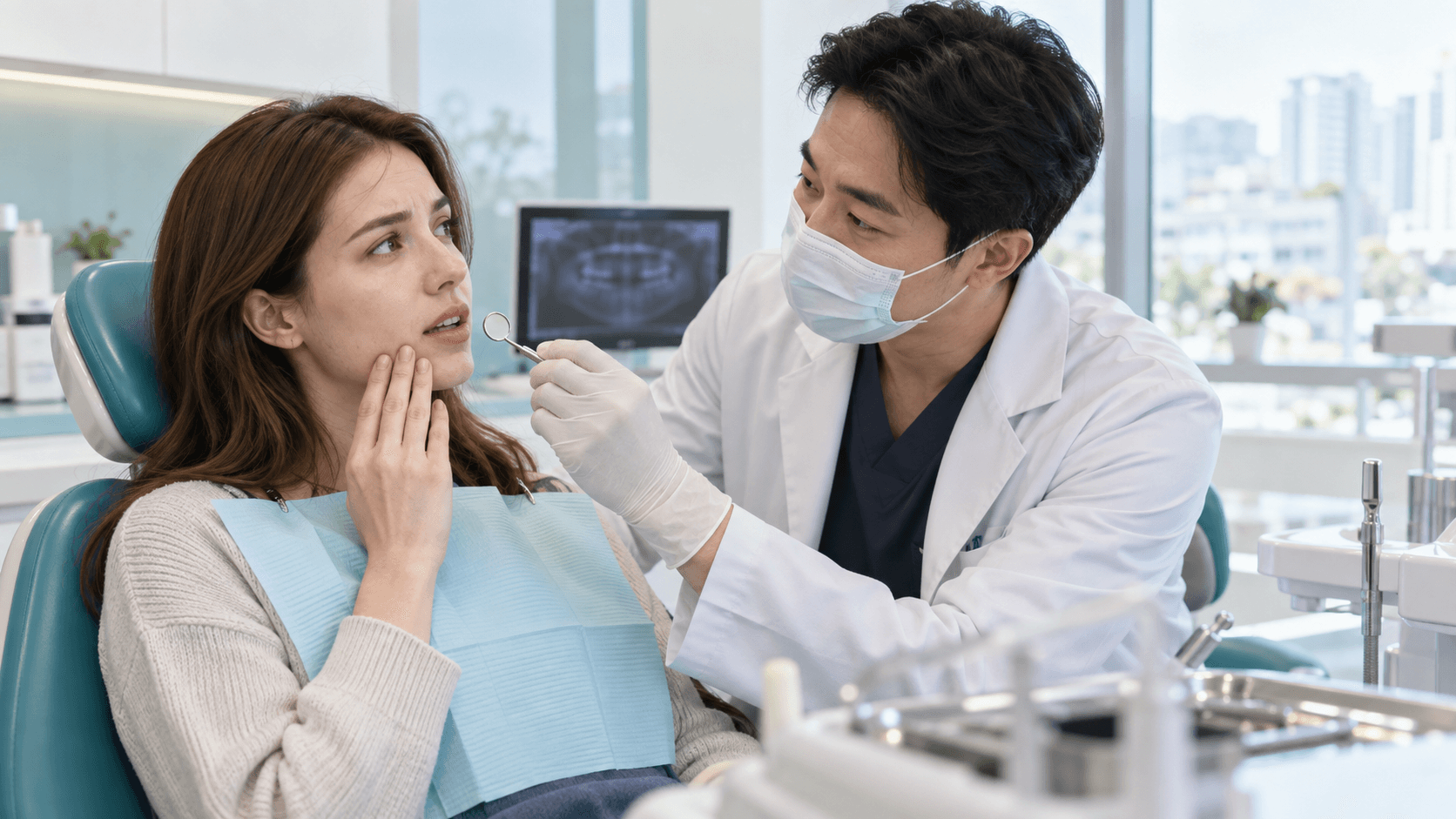
That sharp twinge from something cold, hot, or sweet is one of the most common dental complaints — and it's usually very treatable once you know the cause. Here's why teeth get sensitive, what a dentist in Korea can do, and how to ease it at home — in English.
A sharp, sudden twinge from something cold, hot, sweet, or even a breath of cold air — sensitive teeth are one of the most common reasons people see a dentist. The good news: once you know what's causing it, it's usually very treatable. Here's what's going on and how it's handled in Korea, in English for foreign residents.
Why teeth get sensitive
Sensitivity happens when the softer layer under your enamel (the dentine) gets exposed. Common reasons include:
- Worn enamel — from brushing too hard, or frequent acidic food and drinks.
- Receding gums — which expose the root of the tooth. This is often linked to gum disease.
- A cavity or a cracked tooth — decay or a crack lets temperature and sweetness reach the nerve.
- Teeth grinding — clenching and grinding slowly wears the enamel down.
- After a whitening treatment or a new filling — this kind of sensitivity is usually temporary and settles in a few days.
When to see a dentist
Mild, general sensitivity can often be managed at home. See a dentist if:
- it's focused on one tooth, or keeps getting worse,
- it lingers for a long time after the hot or cold is gone, or
- there's visible damage, a dark spot, or pain when you bite.
Those can point to a cavity, a crack, or a nerve problem that needs treatment — sometimes a filling, or a root canal if the nerve is involved. A checkup and scaling is the reliable way to find the cause.
What a dentist can do
Treatment depends on the cause:
- Fluoride or desensitising treatment applied in the clinic to strengthen the enamel.
- Fixing the cause — filling a cavity, treating receding gums, or a night guard if you grind.
- Bonding to cover an exposed, sensitive root surface.
- A root canal, only if the sensitivity means the nerve itself is affected.
Managing it at home
- Use a desensitising toothpaste — it works best used every day over a couple of weeks, not just once.
- Switch to a soft brush and a gentle technique, and don't brush straight after acidic food or drink.
- Ease off very hot, cold, or acidic things for a while.
- Don't ignore sensitivity that lasts — it's often a signal of something simple and fixable, caught early.
At Seoul Lab Dental: we find out why your teeth are sensitive with a 3D scan, treat the cause rather than just the symptom, and explain your options and the cost in English before we start.
Frequently asked questions
Why are my teeth suddenly sensitive?
Common causes are worn enamel (hard brushing or acidic foods), receding gums that expose the root, a cavity or cracked tooth, teeth grinding, or a recent whitening treatment or filling. Sensitivity after whitening or a filling is usually temporary; the others are worth checking.
Does sensitivity mean I have a cavity?
Not always — general sensitivity is often from worn enamel or receding gums. But sensitivity focused on one tooth, or that keeps getting worse or lingers, can be a cavity, crack, or nerve issue, so it's worth having it checked.
Does desensitising toothpaste actually work?
For mild sensitivity, yes — but it works gradually, so use it every day for a couple of weeks rather than expecting an instant fix. If the sensitivity persists or is focused on one tooth, see a dentist to find the cause.
Can a dentist fix sensitive teeth?
Usually, yes. Depending on the cause, that might be a fluoride or desensitising treatment, filling a cavity, treating gum recession, a night guard for grinding, bonding over an exposed root, or a root canal if the nerve is involved.
Can I get it explained in English?
Yes. At Seoul Lab Dental we explain what's causing your sensitivity and your treatment options in English before any treatment begins.
Want a clear estimate for your treatment?
Book a 3D scan and consultation — you'll leave knowing your treatment plan and exact cost.
Get my estimate