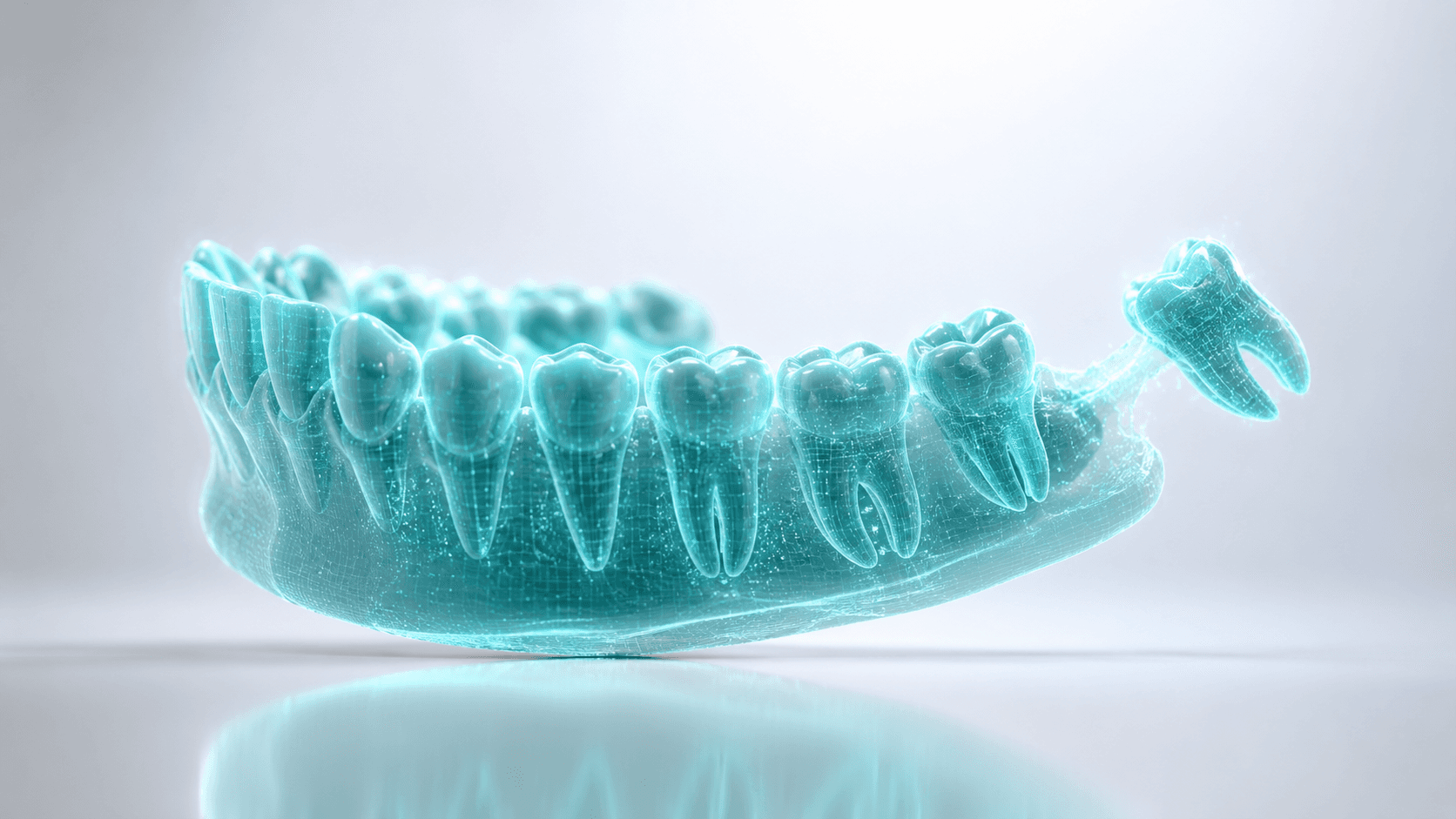
Wisdom teeth don't always need to be removed — but when they do, it helps to know what to expect. Here's a plain-English guide to having them taken out in Korea, including what makes one extraction harder than another.
Wisdom teeth (third molars) are the last to come in, and there's often not enough room for them. Sometimes they're fine and can stay. Other times they're impacted, hard to clean, or causing problems — and removal is the sensible option.
When a wisdom tooth should come out
A dentist may recommend removal if the tooth is:
- Impacted — stuck under the gum or at an angle
- Causing pain, swelling, or repeated infection
- Decayed or hard to keep clean because of its position
- Pushing on the tooth next to it
A 3D scan shows the tooth's position and its relationship to the nerve, which is the key to a safe, planned extraction.
The real damage is usually to the tooth next door
It's worth being clear about why a dentist pushes on this, because a wisdom tooth that doesn't hurt can feel like a non-problem.
A wisdom tooth leaning against the molar in front creates a space between them that no toothbrush reaches. Decay forms on the back surface of that second molar — a surface that's difficult to restore and, if the cavity goes deep enough, can cost you a tooth you actually use for chewing. The same pocket collects bacteria and produces localised gum disease around both teeth.
So the calculation is rarely "is this wisdom tooth painful?" It's "is this wisdom tooth going to take the tooth in front with it?"
How it's sitting changes everything
Not all extractions are the same procedure, and this is what determines how long it takes, how you'll feel afterward, and what it costs:
| Position | What it usually means |
|---|---|
| Fully erupted, upright | The simplest case — often a straightforward tooth extraction |
| Partially erupted | Gum covers part of the tooth; food and bacteria collect under the flap |
| Soft-tissue impacted | Still under the gum, but above the bone |
| Bony impacted, or lying sideways | Under bone and/or angled into the tooth in front; usually removed in sections |
A tooth removed in sections isn't a complication — it's the deliberate way to take out an angled tooth without forcing it, and it's gentler on the bone than trying to lift it whole.
Why the lower jaw needs a CT
A nerve runs through the lower jaw supplying feeling to the lip and chin, and the roots of a lower wisdom tooth sometimes sit very close to it. A flat X-ray shows the two overlapping but can't show whether they're touching or simply lined up in the image.
A 3D CT shows the actual distance and the direction the roots run. That's what the plan is built on: how to remove the tooth, whether to section it, and what to tell you about the risks that apply to your case specifically. If a clinic proposes a lower wisdom tooth extraction without imaging that answers this, ask why.
Upper wisdom teeth and the sinus
Upper wisdom teeth are usually quicker to remove — the bone is less dense. The thing to know is that the maxillary sinus sits just above them, and occasionally the root is separated from it by very little bone.
That's why aftercare for an upper extraction sometimes includes not blowing your nose forcefully for a while. It's a precaution, and your dentist will tell you if it applies to you.
What the procedure is like
- It's done under local anaesthetic, so the area is numb.
- A simple extraction is quick; an impacted tooth may need a small procedure to remove it in sections.
- You'll get clear aftercare instructions — this matters as much as the extraction itself.
You'll feel pressure and hear sounds, which surprises people the first time. Pressure is normal; sharp pain isn't — say so and more anaesthetic can be given.
How long the whole thing takes
The appointment itself is usually shorter than people expect. The part to plan around is the recovery.
Most people take it easy for the rest of the day, feel the peak of swelling around the second or third day, and are back to normal within a few days to a week. A difficult bony impaction is at the longer end of that; an upright, fully erupted tooth is at the shorter end. If you're having more than one removed, ask whether to do them together or in stages — it's a trade-off between fewer disruptions and an easier recovery each time.
If you have something you can't move — a trip, an exam, a presentation — say so when booking, and don't schedule the extraction right before it.
Recovery
- Some swelling and soreness for a few days is normal. Cold compresses and the painkillers you're advised to take help.
- Eat soft foods, avoid vigorous rinsing on day one, and don't smoke or use straws (they can dislodge the healing clot).
- Most people are back to normal within a few days to a week.
Dry socket, and how to avoid it
This is the complication people have usually heard of. A blood clot forms in the socket and protects the bone underneath while it heals. If that clot is dislodged or breaks down early, the bone is left exposed — which is painful, typically starting a few days after the extraction rather than immediately, and often felt along the jaw or towards the ear.
What raises the risk: smoking, sucking through a straw, vigorous rinsing or spitting in the first day, and disturbing the site with your tongue. What to do if you think you have it: call the clinic. It's treated — the socket is cleaned and dressed — and it settles much faster with treatment than without.
When to call the clinic
Don't wait it out if you have:
- Pain that increases after day three rather than easing
- Swelling that keeps growing after the second or third day
- Bleeding that doesn't slow with firm pressure on gauze
- A fever, or difficulty opening your mouth or swallowing
- Numbness in the lip or chin that hasn't worn off long after the anaesthetic should have
None of these are common, and all of them are easier to deal with early.
At Seoul Lab Dental: we plan wisdom-tooth removal from a 3D scan — including how the roots sit relative to the nerve — explain the position and the risks that apply to your case in English, and give you written aftercare so recovery is smooth.
Cost and insurance
Medically necessary extractions are often partly covered by NHIS, so your out-of-pocket cost is usually a co-payment rather than full price. We confirm the specifics in writing after your exam.
The figure varies with difficulty — an upright tooth and a sideways bony impaction are not the same procedure — and imaging may be a separate line. That's normal; what matters is seeing it itemised. Our guide to dental costs in Korea explains how to read one.
Questions worth asking before you agree
- Does this one actually need to come out, or can it be monitored?
- Can you show me on the CT how close the roots are to the nerve?
- Will it be removed whole or in sections, and roughly how long will it take?
- How much recovery time should I plan for?
- What's covered by NHIS here, and what's the itemised cost?
Frequently asked questions
Do all wisdom teeth need to be removed?
No. If they're healthy, fully erupted, and you can keep them clean, they can stay. Removal is advised when they're impacted, painful, infected, or hard to clean — and especially when they're damaging the molar in front. A scan and exam decide.
Does it hurt to have a wisdom tooth out?
The procedure is done under local anaesthetic, so the area is numb. You'll feel pressure and hear sounds, which is normal; sharp pain isn't, so say so if you feel it. Some swelling and soreness for a few days afterward is normal and managed with the painkillers you're advised to take.
Why does my wisdom tooth need a CT scan?
For lower wisdom teeth, a nerve supplying the lip and chin runs through the jaw, and the roots sometimes sit close to it. A flat X-ray can show them overlapping without showing the real distance. A 3D CT shows it, which is what the extraction plan is based on.
What is dry socket and how do I avoid it?
The clot that forms in the socket protects the bone while it heals. If it's dislodged early, the exposed bone is painful — usually starting a few days after the extraction. Avoid smoking, straws, vigorous rinsing and poking the site. If you think you have it, call the clinic: it's treated and settles much faster with treatment.
Is wisdom tooth extraction covered by insurance in Korea?
Medically necessary extractions are often partly covered by NHIS, so you usually pay a co-payment. The amount varies with difficulty, and imaging may be a separate line. We confirm the exact itemised figure in writing after your exam.
Can the procedure be explained in English?
Yes. At Seoul Lab Dental we plan the extraction from a 3D scan and explain the position, the procedure, the risks that apply to your case, and aftercare in English.
Want a clear estimate for your treatment?
Book a 3D scan and consultation — you'll leave knowing your treatment plan and exact cost.
Get my estimate