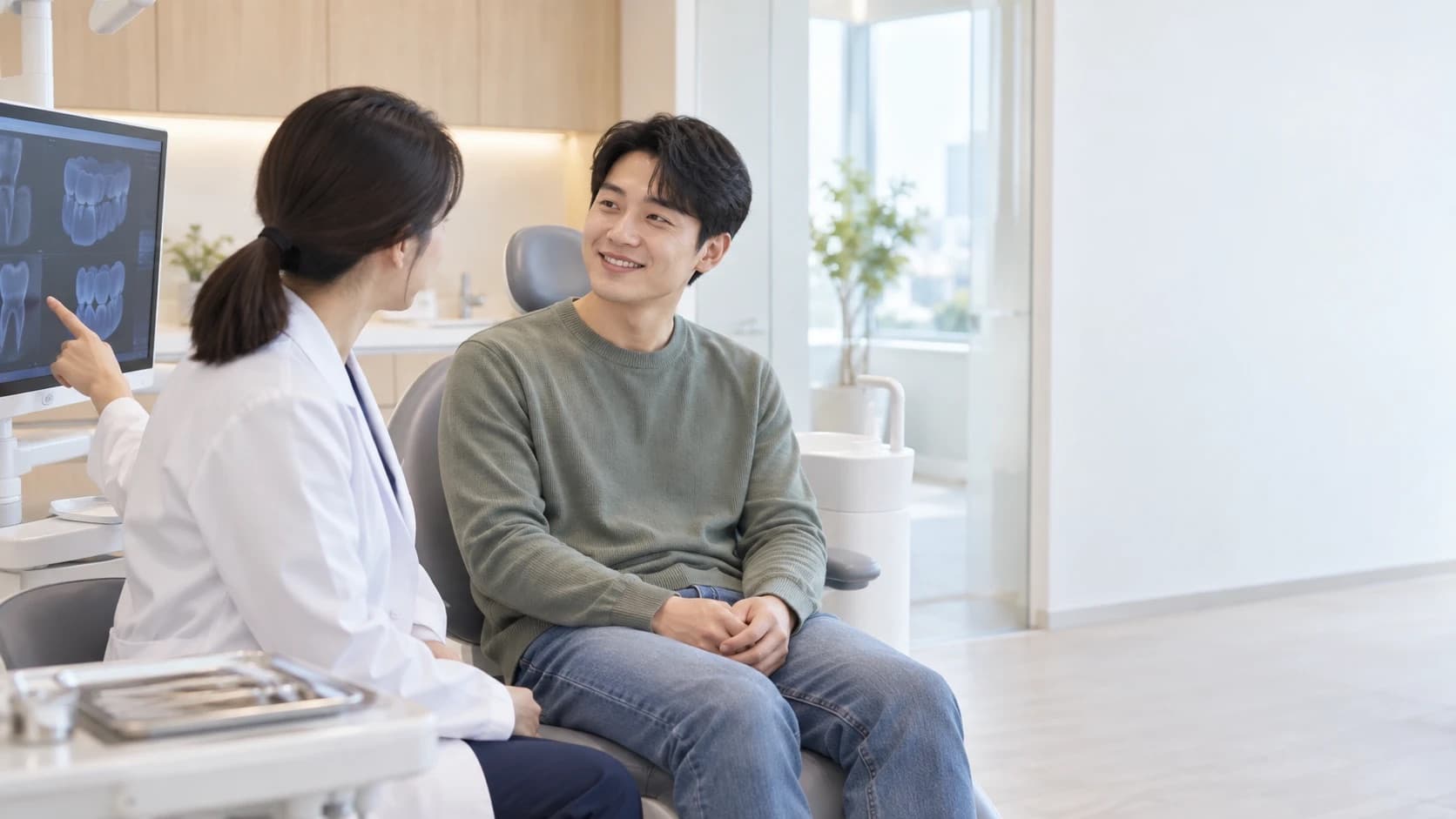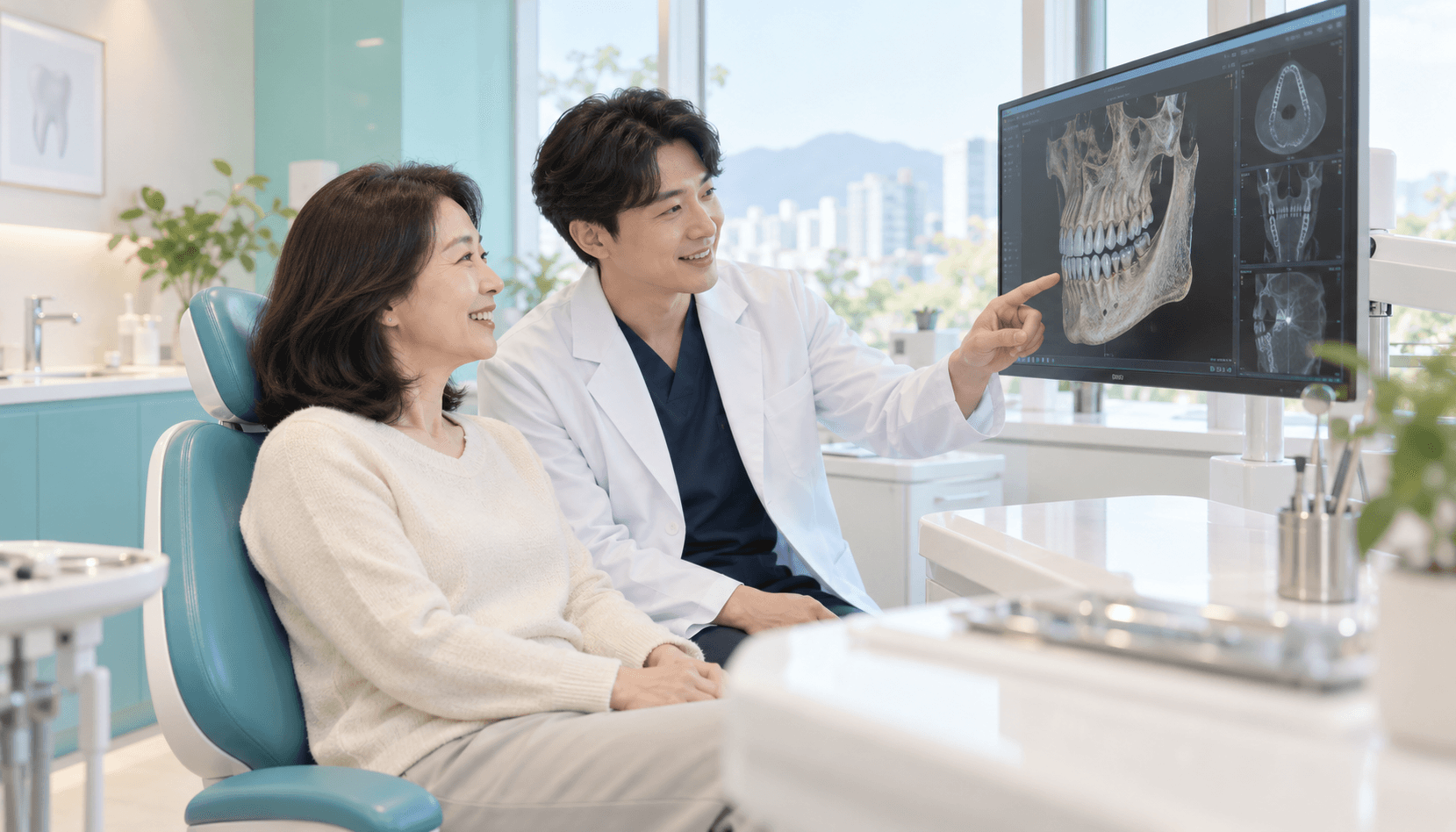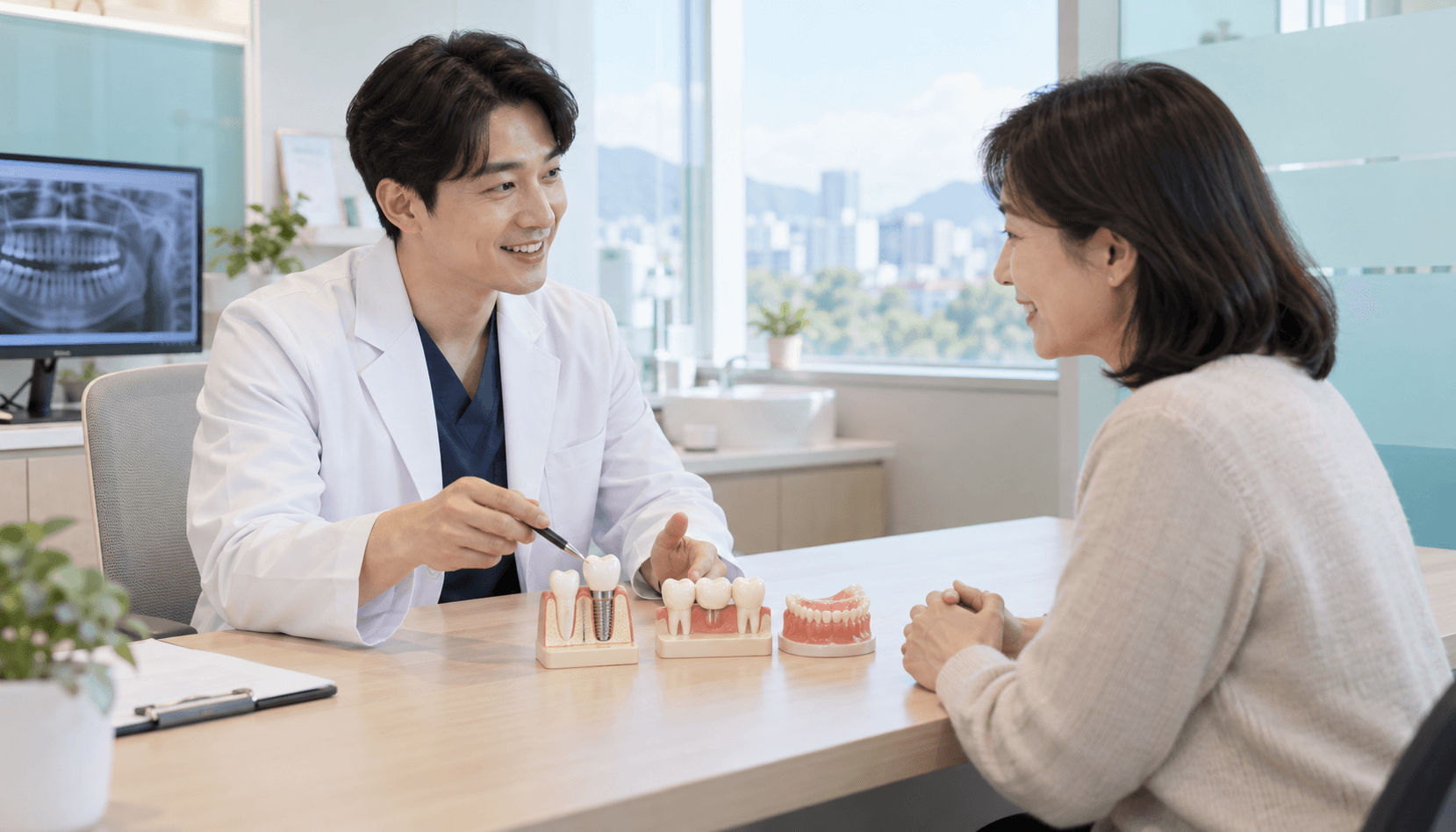
Even at a clinic that treats you in English, some Korean helps — at reception, at the pharmacy afterwards, and on the phone when you're trying to be seen today. Here are the words that actually come up, with pronunciation.
You can be treated entirely in English in Korea. But the clinic is only part of the trip: there's the person at the front desk, the pharmacy afterwards, and the phone call when something starts hurting on a Saturday. A small, specific vocabulary covers almost all of it. Here's the one that matters, written for foreign residents.
Why you still need some of this
An English-speaking dentist solves the part where you need to understand a diagnosis. It doesn't solve:
- Reception — booking, your ARC, insurance, and the payment desk
- The pharmacy — where your prescription is filled, usually by someone who doesn't work in English
- The phone — especially when you're trying to be seen the same day
- Being understood precisely — "it hurts" and "it throbs when I lie down" lead to different examinations
Saying what's wrong
The pronunciation column is a rough guide, not a transliteration standard — say it as written and you'll be understood.
| English | Korean | Say it like |
|---|---|---|
| My tooth hurts | 이가 아파요 | ee-ga a-pa-yo |
| It hurts here | 여기가 아파요 | yeo-gi-ga a-pa-yo |
| It throbs | 욱신거려요 | uk-shin-geo-ryeo-yo |
| It's sensitive to cold | 차가운 게 시려요 | cha-ga-un ge shi-ryeo-yo |
| It hurts when I bite | 씹을 때 아파요 | ssi-beul ttae a-pa-yo |
| My gum is swollen | 잇몸이 부었어요 | in-mo-mi bu-eo-sseo-yo |
| My gums bleed | 잇몸에서 피가 나요 | in-mo-me-seo pi-ga na-yo |
| A tooth broke | 이가 깨졌어요 | ee-ga kkae-jyeo-sseo-yo |
| My filling fell out | 때운 게 빠졌어요 | ttae-un ge ppa-jyeo-sseo-yo |
| It started three days ago | 사흘 전부터요 | sa-heul jeon-bu-teo-yo |
| It's very painful | 많이 아파요 | ma-ni a-pa-yo |
The parts of your mouth
| English | Korean | Say it like |
|---|---|---|
| Tooth | 이 / 치아 | ee / chi-a |
| Gum | 잇몸 | in-mom |
| Front tooth | 앞니 | am-ni |
| Back tooth / molar | 어금니 | eo-geum-ni |
| Wisdom tooth | 사랑니 | sa-rang-ni |
| Nerve | 신경 | shin-gyeong |
| Jaw joint (TMJ) | 턱관절 | teok-gwan-jeol |
| Upper / lower | 위 / 아래 | wi / a-rae |
| Left / right | 왼쪽 / 오른쪽 | oen-jjok / o-reun-jjok |
If you remember only one of these, make it 어금니 and 앞니 — pointing plus "back tooth" or "front tooth" gets you most of the way.
Treatment words you'll hear back
These are the words that come at you, and knowing them means you can follow the conversation even when it moves fast:
| Korean | Say it like | What it means |
|---|---|---|
| 충치 | chung-chi | Cavity |
| 때우다 | ttae-u-da | To fill (a cavity) |
| 신경치료 | shin-gyeong-chi-ryo | Root canal treatment |
| 발치 | bal-chi | Extraction |
| 스케일링 | seu-ke-il-ling | Scaling / cleaning |
| 잇몸치료 | in-mom-chi-ryo | Gum treatment |
| 크라운 | keu-ra-un | Crown |
| 임플란트 | im-peul-lan-teu | Implant |
| 교정 | gyo-jeong | Orthodontics |
| 마취 | ma-chwi | Anaesthetic |
| 엑스레이 | ek-seu-re-i | X-ray |
| 이갈이 | ee-ga-ri | Teeth grinding |
A few of these are borrowed from English and sound close to it — 크라운, 임플란트, 스케일링, 엑스레이. You'll catch more than you expect.
At reception
| English | Korean | Say it like |
|---|---|---|
| I'd like to make an appointment | 예약하고 싶어요 | ye-ya-ka-go shi-peo-yo |
| Can I be seen today? | 오늘 진료 되나요? | o-neul jil-lyo doe-na-yo |
| I don't have an appointment | 예약 안 했어요 | ye-yak an hae-sseo-yo |
| Here's my ARC | 외국인등록증이에요 | oe-gu-gin-deung-nok-jeung-i-e-yo |
| Is it covered by insurance? | 보험 되나요? | bo-heom doe-na-yo |
| How much will it be? | 얼마예요? | eol-ma-ye-yo |
| Do you speak English? | 영어 되세요? | yeong-eo doe-se-yo |
보험 되나요? is the single most useful sentence on this page. It's the question that decides whether you're paying a co-payment or the full fee, and our guide to NHIS dental coverage explains which treatments fall on each side.
At the pharmacy
Your prescription is filled at a 약국 (yak-guk), usually right next to the clinic. The pharmacist may not work in English, but the exchange is short and predictable:
| English | Korean | Say it like |
|---|---|---|
| Prescription | 처방전 | cheo-bang-jeon |
| Painkiller | 진통제 | jin-tong-je |
| Antibiotic | 항생제 | hang-saeng-je |
| How do I take this? | 어떻게 먹어요? | eo-tteo-ke meo-geo-yo |
| After meals | 식후 | shi-ku |
| Three times a day | 하루 세 번 | ha-ru se beon |
| I'm allergic to… | …알레르기 있어요 | …al-le-reu-gi i-sseo-yo |
If you have a drug allergy, say it at the clinic, before the prescription is written — not at the pharmacy after.
Phrases for when you don't follow
These matter more than the vocabulary. Nobody minds being asked to slow down:
| English | Korean | Say it like |
|---|---|---|
| Could you say that again? | 다시 말해 주세요 | da-shi mal-hae ju-se-yo |
| Slowly, please | 천천히요 | cheon-cheon-hi-yo |
| I don't understand | 잘 모르겠어요 | jal mo-reu-ge-sseo-yo |
| Could you write it down? | 써 주실 수 있어요? | sseo ju-shil su i-sseo-yo |
| Wait a moment, please | 잠시만요 | jam-shi-man-yo |
써 주실 수 있어요? is worth memorising. A written word can go into a translation app; a spoken one often can't.
What to do if it isn't working
If you're mid-appointment and lost, stop and say 잠시만요. Type what you need into a translation app and show the screen — every clinic in Korea has seen this and nobody finds it strange.
And for anything where you need to weigh options rather than just be treated — implants, orthodontics, anything with a quote attached — it's worth going somewhere the conversation happens in a language you're fluent in. Our guide to finding an English-speaking dentist covers how to check that before you book.
At Seoul Lab Dental: your diagnosis, the options, the timeline and the cost are explained in English, and you get the estimate in writing before treatment starts. You won't need any of the phrases above with us — but they'll serve you everywhere else in Korea.
Frequently asked questions
How do I say "my tooth hurts" in Korean?
이가 아파요 — say it like "ee-ga a-pa-yo". To point at the spot, 여기가 아파요 ("yeo-gi-ga a-pa-yo") means "it hurts here".
What is TMJ in Korean?
The jaw joint is 턱관절 ("teok-gwan-jeol"), and TMJ disorder is 턱관절장애 ("teok-gwan-jeol-jang-ae"). It's a recognised condition in Korea and NHIS covers diagnosis and conservative treatment such as a splint.
How do I ask whether treatment is covered by insurance?
보험 되나요? — "bo-heom doe-na-yo". It's the most useful sentence on this page, because the answer decides whether you pay a co-payment or the full fee.
Do I need Korean if the dentist speaks English?
Not for the treatment itself, but reception, the pharmacy and same-day phone calls often run in Korean. A short vocabulary covers nearly all of it, and 써 주실 수 있어요? ("could you write it down?") handles the rest — a written word goes into a translation app, a spoken one usually doesn't.
What should I say at the pharmacy?
Hand over the 처방전 (prescription). Useful follow-ups are 어떻게 먹어요? ("how do I take this?") and 하루 세 번 / 식후 ("three times a day" / "after meals"). Tell the clinic about any drug allergy before the prescription is written, not the pharmacy afterwards.
Is it rude to use a translation app in the clinic?
Not at all. Say 잠시만요 ("one moment please"), type what you need and show the screen. Every clinic in Korea has patients who do this.
Want a clear estimate for your treatment?
Book a 3D scan and consultation — you'll leave knowing your treatment plan and exact cost.
Get my estimate